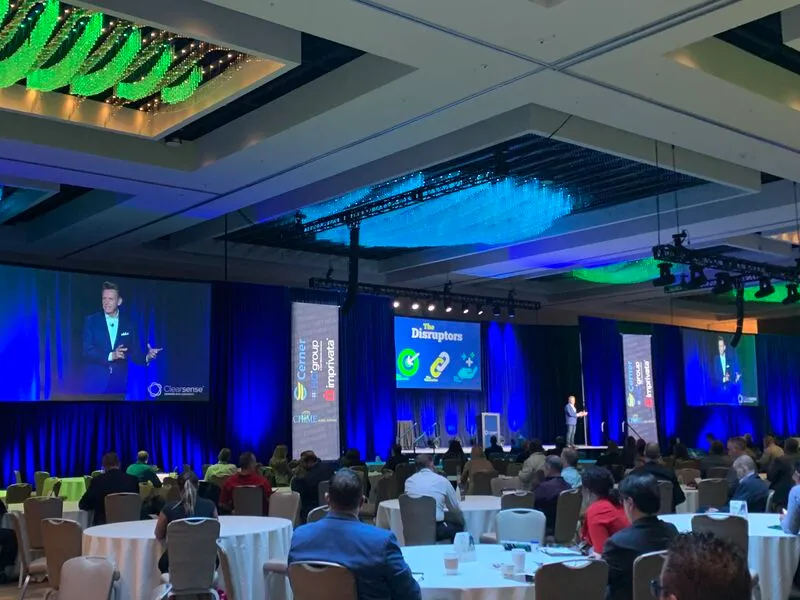
At first glance, the idea that healthcare keynote speakers are artists may sound unusual. Healthcare is often described as clinical, regulated, and data-driven. Art, on the other hand, is emotional, expressive, and subjective. Yet after more than two decades speaking to healthcare audiences around the world, I’ve come to believe this comparison is not only accurate, it is essential to understanding what separates good speakers from truly exceptional ones.
Virtually anyone can stand on a stage and present information. With enough preparation, most people can deliver content that is accurate and intelligible. That is the easy part. The hard part is transforming content into meaning, and meaning into impact. That transformation is where artistry lives.
Healthcare audiences do not need more slides. They need perspective. They need clarity. They need to feel something that helps them reconnect with purpose in an industry that can be exhausting and unforgiving. The best healthcare keynote speakers understand this intuitively. They approach the stage not just as experts, but as artists of human connection.
Artistry in speaking does not mean theatrics. It does not mean exaggeration or performance for its own sake. True artistry is about intention. It is about how ideas are shaped, how stories are told, and how emotion is balanced with rigor. It is about knowing what to say, what not to say, and when silence is more powerful than another statistic.
In healthcare, this balance is especially delicate. Audiences expect credibility. They expect evidence. They expect respect for the seriousness of their work. At the same time, they are human beings who carry stress, fatigue, and often quiet frustration. A great healthcare speaker knows how to honor both realities at once.
This is why artistry matters so much.
The artist-speaker understands narrative. They know that people remember stories far more than data points. They use narrative not to oversimplify, but to contextualize. A story becomes a vessel that carries complex ideas in a way that feels accessible and human.
They also understand emotional cadence. Every audience has an emotional rhythm. There are moments when people are ready to be challenged and moments when they need reassurance. There are moments when humor opens the door and moments when gravity demands respect. Navigating this rhythm is not something that can be scripted in advance. It requires presence and sensitivity.
Visual language is another part of the artistry. Slides are not documents. They are supporting elements of an experience. The best healthcare speakers use visuals sparingly and intentionally. They know that clutter distracts and simplicity amplifies meaning. A single image or phrase, used well, can anchor an idea in memory far longer than a dense chart.
Perhaps most importantly, artistry in speaking is about authenticity. Audiences can sense when a speaker is hiding behind credentials or rehearsed lines. They respond differently when a speaker is fully present, honest about uncertainty, and willing to share hard-earned insights rather than polished conclusions.
This is why no certification, credential, or training program can manufacture great speakers. Technique can be taught. Authentic connection cannot. The art of speaking lives in how a person sees the world, how they listen, and how they relate to others.
I often use an analogy when discussing this with meeting planners. I could take art classes for the rest of my life, but I would never paint like a master artist. I might learn technique, but I would never replicate the depth of perception or expression that defines true artistry. Speaking works the same way.
Great healthcare speakers don’t just deliver information. They paint pictures. They help audiences see the future more clearly, understand their role within it, and reconnect with the humanity of their work. They bring beauty into conversations that are often dominated by urgency and constraint.
This may seem counterintuitive in healthcare, but it is precisely why artistry matters. When people feel emotionally connected, they are more open to change. When they feel seen and understood, they are more willing to engage. When they experience beauty, even briefly, they remember why their work matters.
The most impactful healthcare keynotes I’ve witnessed were not remembered for their data alone. They were remembered for moments. A story that reframed a challenge. A pause that allowed reflection. A sentence that captured a truth people had felt but never articulated.
Read More: HEALTHCARE TRENDS IN 2026
That is the art.
When selecting a healthcare keynote speaker, credentials matter. Experience matters. But artistry is what transforms a presentation into an experience. It is what turns a keynote into a moment people carry with them long after the event ends.
In an industry that deals daily with complexity, pressure, and consequence, the ability to deliver humanity and beauty alongside insight is not a luxury. It is a necessity.
That is why the best healthcare keynote speakers are, at their core, artists.
For booking inquiries or to learn more about Nicholas Webb’s customized healthcare keynotes, visit www.nickwebb.com